From the Page: A Life Study Specimen
From the Page
What follows shows how the five instruments of the method, the conversations, the archive, the residency, the circle, and the image, are brought together on a single page, typeset as it would appear in a finished volume.
Esther Mokoena · A Life in Full
Chapter Four
The Ledger and the Left Hand
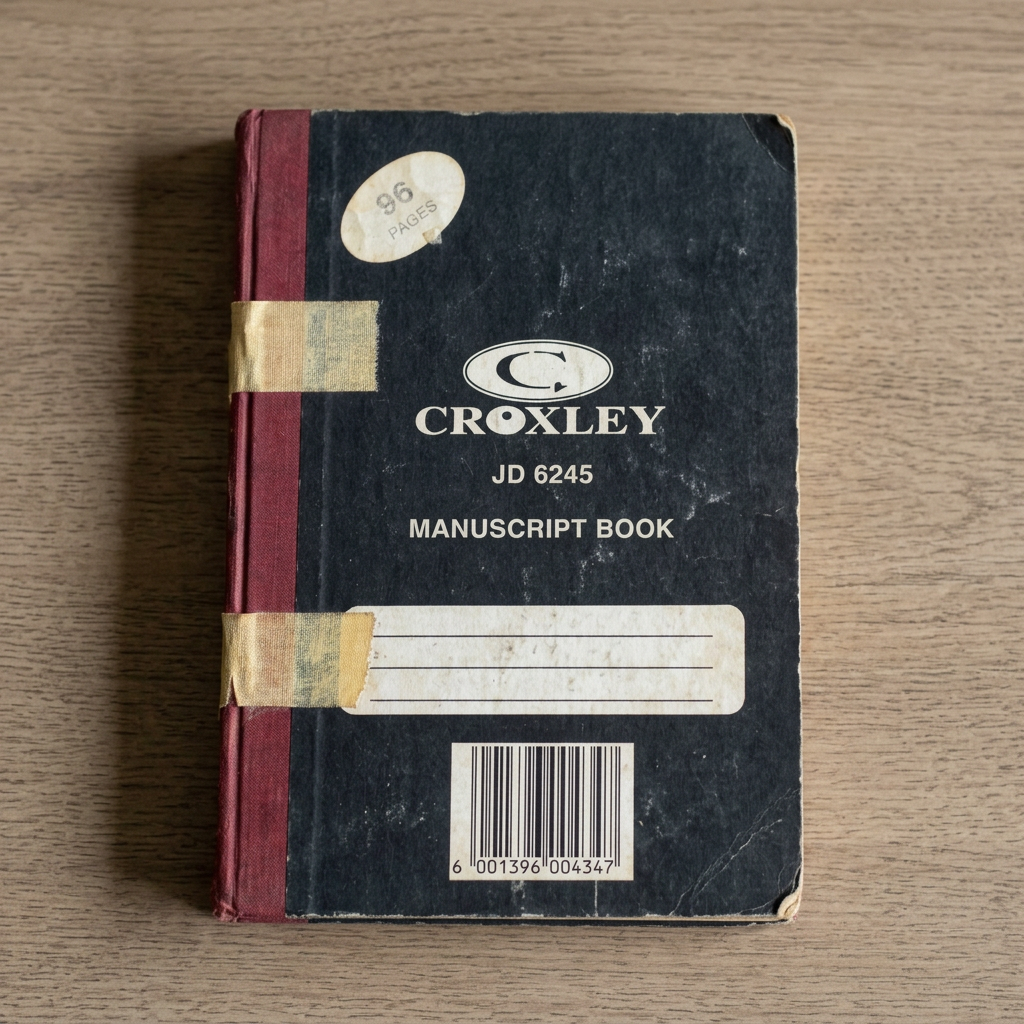
The transport ledger, Pretoria North, 2026. Photographer: Zukiswa Phoofolo.
The ledger is the first thing she shows me and the last thing she lets me touch. A hardcover Croxley book, 1976, the spine mended twice with what looks like surgical tape. Every entry is in blue ink, in the compressed, forward-leaning hand of a woman recording money she could not afford to lose. Except one. On the ninth page, in black ink, in a looser hand, as if written standing up, or shaking: Bus. Paid. God help us.
For three weeks I believed that entry was the beginning of the story. The archive said so. The family said so. She had said so herself, weeks before I ever entered the house, in the third of our recorded conversations, her voice steady down the line: we paid for the bus, and then we fetched it. In that order, she said. You can write it in that order. And the framed photograph in the hallway says so too: Esther Mokoena, thirty-one years old, in her church dress on a working morning, her arm at full stretch, her hand on the bonnet of a 1974 Bedford. Not leaning on it. Not resting. Touching it the way you touch a thing for the record, so that the photograph will have to say: mine. Behind her, the street has stopped walking.
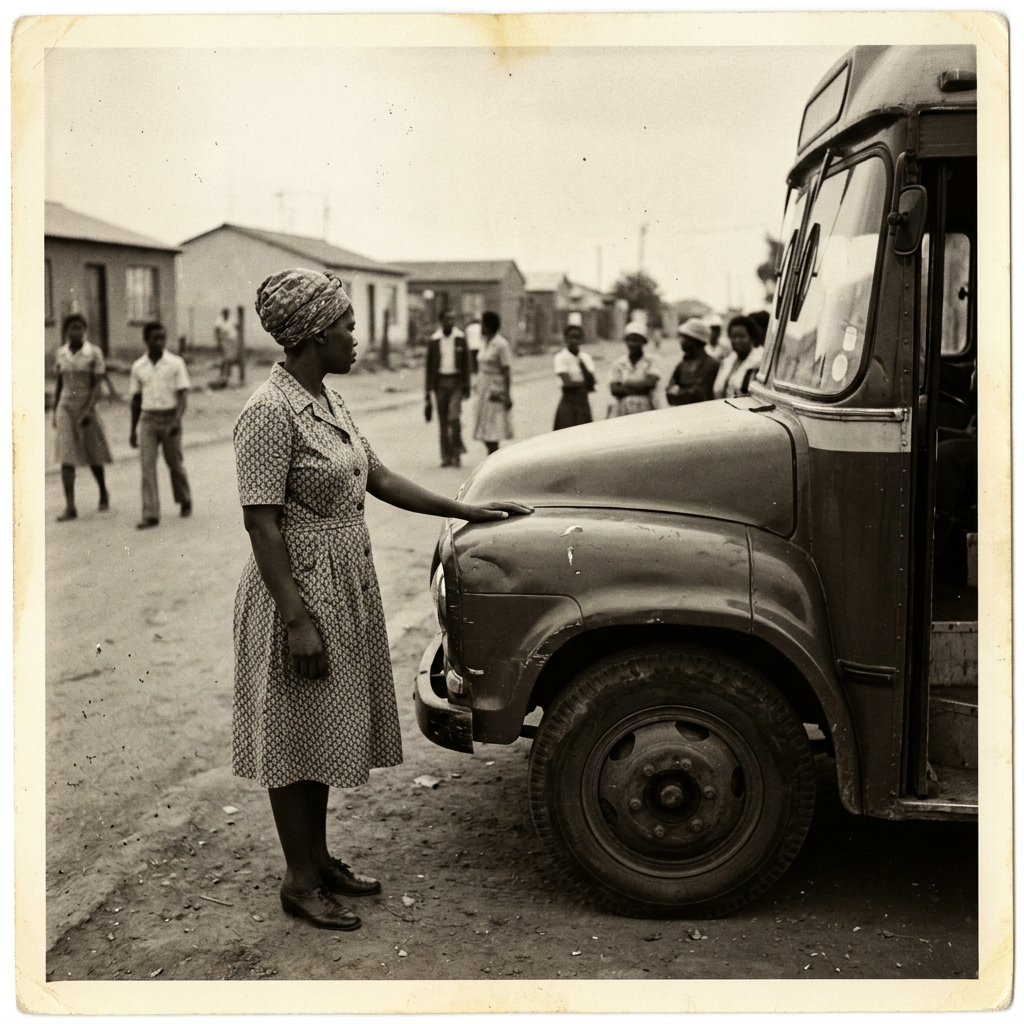
Esther Mokoena, Atteridgeville, 1977. Photographer: the dealer’s brother.
Then I met Petrus Mahlangu.
Field Notes · Petrus’s Stoep · Ga-Rankuwa · 16:40
He is ninety-one and he drove the first bus for eleven years and he laughed for a long time when I read him the ledger entry. She had that bus four months before she paid for it, he said. Four months. I drove it in the dark so the dealer’s brother would not see it on the Mabopane road. You write that down. She will deny it. Write it down anyway.
I wrote it down. She denied it, and the denial is also true. In the world Esther Mokoena built, that bus was paid for from the moment she gave her word it would be; the four months were the bank catching up with her.
And here is where a conventional biography would make its quiet, forgivable mistake. It would choose. It would settle the four months, privately, in the writer’s room, and hand the family a clean line, as if the point of listening to a life were to rule on it. But the gap between the ledger and Petrus is not an error waiting for correction. It is the finding. The ledger was written for God. The bus was driven for the bank. Both are true, and the woman who could hold both truths on the same road, in the same dark, is the woman who turned one Bedford into the largest black-owned transport fleet north of Pretoria, and no account that flattens the contradiction has understood the first thing about her.
The recorded conversations that begin a book like this one began, in her case, three weeks late. The tablet her children had bought her for the calls was still in its box, the protective plastic still on the screen, because a woman who has hired and fired auditors was not going to tell a stranger that a machine had declined her instructions. Three weeks of calls were attributed to weather, to church, and to the funeral of someone she later conceded, laughing, she did not know well. Then her grandson Katlego, who calls her Koko and nothing else, came for Sunday lunch, peeled the plastic off, downloaded the Google Meet app no one had thought to check for, and we spoke that same evening for two hours.
She is eighty-four now, and her mornings run to a timetable no one set but her. Five o’clock, the teacups, rinsed before the helper arrives, because, she tells me on my ninth day in the house, no one who works for me will ever find my dirt. She means the teacups. She also means everything else in this book. I laughed anyway, because my own mother says the same thing, in the same tone, and means it the same two ways. Six o’clock, the window, opened onto the road, where she counts the first buses out by sound alone and can tell from the pitch of a gearbox which driver is running late. Seven o’clock, the depot telephones with the morning report, a courtesy nobody has dared to retire; she takes it standing, the way she has taken it for fifty years. The grandchildren who run the fleet now send her the day’s numbers each evening, and the ones who run nothing but their own lives, in London and in Perth, send photographs instead, which she reads the way she once read ledgers, line by line, for what they hold and for what they leave out. A woman who once ran forty buses to the minute now runs a morning the same way, and the cargo is what it always was: people, carried.
The telephone has a grammar too, and I have learned it. WhatsApp is for family, and the family group is a register. When she sends the garden to it, the roses she planted the year the second depot opened, she counts the replies the way she once counted the evening takings, and a child who has read and not answered by supper gets a telephone call to establish whether he is eating. Two grey ticks is delivered. Two blue ticks is read. Read and silent is a matter for the telephone. Voice notes are for blessings and for instructions, in that order. The burial society, which she could by now buy outright and would never leave, gets its subscription hand-delivered on the first of the month, because belonging is not a debit order. And the proportions of the house say what the archive says: one photograph of a bus in the hallway, and a wall of graduations, weddings, and babies everywhere else. Ask her about the fleet and she gives you dates. Ask her about Katlego’s graduation and she gives you the weather, the gown, the row, the seat, and what his late grandfather would have said, word for word, in his voice.
I write this down at the kitchen table while she watches me write it. That is the arrangement. She knows where I am standing. I have told her. I am the stranger she has allowed into the early morning of her life, and everything on these pages was seen from that specific chair, at that specific hour, by a writer she could watch writing.
The photograph in the hallway was taken by the dealer’s brother. She told me that on the last morning, unprompted, drying a cup.
Nobody else knows that, she said. Now you do. Do your job.
47
This is how a life reads when it has been studied, not summarised.